> ## Documentation Index
> Fetch the complete documentation index at: https://luminouslabs-cc5545c6-swen-add-code-runner.mintlify.site/llms.txt
> Use this file to discover all available pages before exploring further.

# Create Compressed Accounts

> Guide to create compressed accounts in Solana programs with full code examples.

Compressed accounts and addresses are created via CPI to the Light System Program.

* Compressed and regular Solana accounts share the same functionality and are fully composable.
* A compressed account has two identifiers: the account hash and its address (optional). In comparison, regular Solana accounts are identified by their address.
* The account hash is not persistent and changes with every write to the account.
* For Solana PDA like behavior your compressed account needs an address as persistent identifier.\
  Fungible state like [compressed token accounts](/compressed-tokens/guides/how-to-create-compressed-token-accounts) do not need addresses.

<Note>
  Find [full code examples at the end](/compressed-pdas/guides/how-to-create-compressed-accounts#full-code-example) for Anchor and native Rust.
</Note>

# Implementation Guide

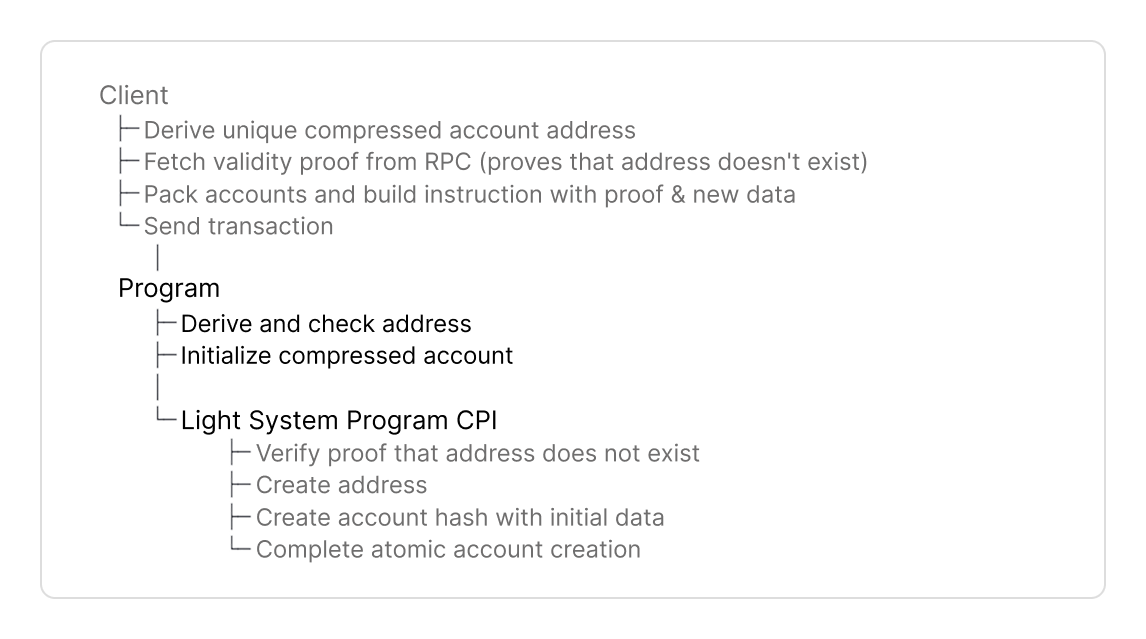
This guide will cover the components of a Solana program that creates compressed accounts.\
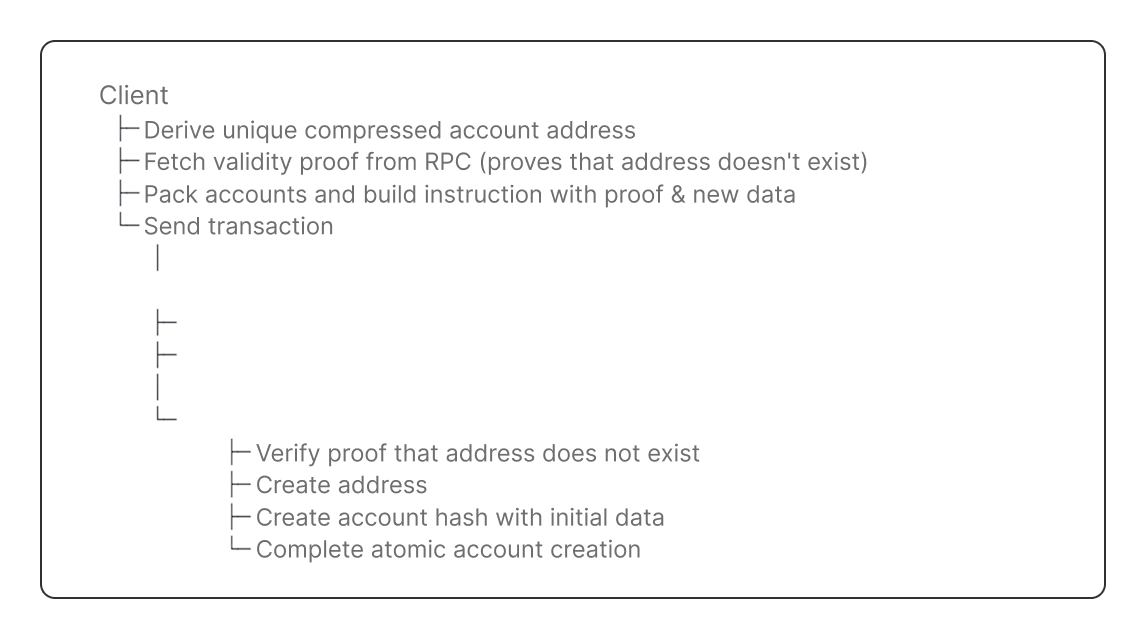
Here is the complete flow:

<div className="hidden dark:block">
  <Frame>
    <img src="https://mintcdn.com/luminouslabs-cc5545c6-swen-add-code-runner/kjqHHw14Q8G9AGL6/images/program-create-1.png?fit=max&auto=format&n=kjqHHw14Q8G9AGL6&q=85&s=21e875336ede6f34cbadcbaa88e17d5f" alt="" width="1146" height="639" data-path="images/program-create-1.png" />
  </Frame>
</div>

<div className="block dark:hidden">
  <Frame>
    <img src="https://mintcdn.com/luminouslabs-cc5545c6-swen-add-code-runner/kjqHHw14Q8G9AGL6/images/program-create.png?fit=max&auto=format&n=kjqHHw14Q8G9AGL6&q=85&s=eb35b398ea74bdaca7eab2a4d3e50b2d" alt="" width="1146" height="639" data-path="images/program-create.png" />
  </Frame>
</div>

<Steps>
  <Step>
    ### Dependencies

    Add dependencies to your program.

    <CodeGroup>
      ```toml Anchor theme={null}
      [dependencies]
      light-sdk = "0.16.0"
      anchor_lang = "0.31.1"
      ```

      ```toml Native Rust theme={null}
      [dependencies]
      light-sdk = "0.16.0"
      borsh = "0.10.0"
      solana-program = "2.2"
      ```
    </CodeGroup>

    * The `light-sdk` provides macros, wrappers and CPI interface to create and interact with compressed accounts.
    * Add the serialization library (`borsh` for native Rust, or use `AnchorSerialize`).
  </Step>

  <Step>
    ### Constants

    Set program address and derive the CPI authority PDA to call the Light System program.

    <CodeGroup>
      ```rust Anchor theme={null}
      declare_id!("rent4o4eAiMbxpkAM1HeXzks9YeGuz18SEgXEizVvPq");

      pub const LIGHT_CPI_SIGNER: CpiSigner =
          derive_light_cpi_signer!("rent4o4eAiMbxpkAM1HeXzks9YeGuz18SEgXEizVvPq");
      ```

      ```rust Native Rust theme={null}
      pub const ID: Pubkey = pubkey!("rent4o4eAiMbxpkAM1HeXzks9YeGuz18SEgXEizVvPq");
      pub const LIGHT_CPI_SIGNER: CpiSigner =
          derive_light_cpi_signer!("rent4o4eAiMbxpkAM1HeXzks9YeGuz18SEgXEizVvPq");
      ```
    </CodeGroup>

    **`CPISigner`** is the configuration struct for CPIs to the Light System Program.

    * CPI to the Light System program must be signed with a PDA derived by your program with the seed `b"authority"`
    * `derive_light_cpi_signer!` derives the CPI signer PDA for you at compile time.
  </Step>

  <Step>
    ### Compressed Account

    <CodeGroup>
      ```rust Anchor theme={null}
      #[event] // declared as event so that it is part of the idl.
      #[derive(
          Clone,
          Debug,
          Default,
          LightDiscriminator
      )]
      pub struct MyCompressedAccount {
          pub owner: Pubkey,
          pub message: String,
      }
      ```

      ```rust Native Rust theme={null}
      #[derive(
          Clone,
          Debug,
          Default,
          BorshSerialize,
          BorshDeserialize,
          LightDiscriminator
      )]
      pub struct MyCompressedAccount {
          pub owner: Pubkey,
          pub message: String,
      }
      ```
    </CodeGroup>

    Define your compressed account struct and derive

    * the standard traits (`Clone`, `Debug`, `Default`),
    * `borsh` or `AnchorSerialize` to serialize account data, and
    * `LightDiscriminator` to implements a unique type ID (8 bytes) to distinguish account types. The default compressed account layout enforces a discriminator in its *own field*, <Tooltip tip="The Anchor framework reserves the first 8 bytes of a *regular account's data field* for the discriminator." cta="Anchor" href="https://www.anchor-lang.com/">not the first 8 bytes of the data field</Tooltip>.

    <Info>
      The traits listed above are required for `LightAccount`. `LightAccount` wraps `my-compressed-account` in Step 7 to set the discriminator and create the compressed account's data.
    </Info>
  </Step>

  <Step>
    ### Instruction Data

    Define the instruction data with the following parameters:

    <Tabs>
      <Tab title="Anchor">
        Anchor handles instruction deserialization automatically. Pass the parameters directly to the instruction function:

        ```rust theme={null}
        pub fn create_account<'info>(
            ctx: Context<'_, '_, '_, 'info, GenericAnchorAccounts<'info>>,
            proof: ValidityProof,
            address_tree_info: PackedAddressTreeInfo,
            output_state_tree_index: u8,
            message: String,
        ) -> Result<()>
        ```
      </Tab>

      <Tab title="Native Rust">
        Define an instruction data struct that will be deserialized from the instruction data:

        ```rust Native Rust theme={null}
        pub struct CreateInstructionData {
            pub proof: ValidityProof,
            pub address_tree_info: PackedAddressTreeInfo,
            pub output_state_tree_index: u8,
            pub message: String,
        }
        ```
      </Tab>
    </Tabs>

    1. **Validity Proof**

    * Define `proof` to include the proof that the address does not exist yet in the specified address tree.
    * Clients fetch a validity proof with `getValidityProof()` from an RPC provider that supports ZK Compression (Helius, Triton, ...).

    2. **Specify Merkle trees to store address and account hash**

    * Define `address_tree_info: PackedAddressTreeInfo` to reference the address tree account used to derive the address in the next step.
    * Define `output_state_tree_index` to reference the state tree account that stores the compressed account hash.

    <Info>
      Clients pack accounts into the accounts array to reduce transaction size. Packed structs like `PackedAddressTreeInfo` contain account indices (u8) instead of 32 byte pubkeys. The indices point to the account in the accounts array to retrieve the public key and other metadata.
    </Info>

    3. **Initial account data**

    * Define fields for your program logic. Clients pass the initial values.
    * This example includes the `message` field to define the initial state of the account.
  </Step>

  <Step>
    ### Derive Address

    Derive the address as a persistent unique identifier for the compressed account.

    <CodeGroup>
      ```rust Anchor theme={null}
      let (address, address_seed) = derive_address(
          &[b"message", ctx.accounts.signer.key().as_ref()],
          &address_tree_info
              .get_tree_pubkey(&light_cpi_accounts)
          &crate::ID,
      );
      ```

      ```rust Native Rust theme={null}
      let (address, address_seed) = derive_address(
          &[b"message", signer.key.as_ref()],
          &instruction_data
              .address_tree_info
              .get_tree_pubkey(&light_cpi_accounts)
          &ID,
      );
      ```
    </CodeGroup>

    **Pass these parameters to `derive_address()`:**

    * `&custom_seeds`: Predefined inputs, such as strings, numbers or other account addresses. This example uses `b"message"` and the signer's pubkey.
    * `&address_tree_pubkey`: The pubkey of the address tree where the address will be created.
      * Retrieved by calling `get_tree_pubkey()` on `address_tree_info`, which unpacks the index from the accounts array.
      * This parameter ensures an address is unique to an address tree. Different trees produce different addresses from identical seeds.
    * `&program_id`: Your program's ID.

    **The SDK returns:**

    * `address`: The derived address for the compressed account.
    * `address_seed`: Pass this to the Light System Program CPI in *Step 8* to create the address.
  </Step>

  <Step>
    ### Address Tree Check (optional)

    Ensure global uniqueness of an address by verifying that the address tree pubkey matches the program's tree constant.

    <Info>
      Every address is unique, but the same seeds can be used to create different addresses in different address trees. To enforce that a compressed PDA can only be created once with the same seed, you must check the address tree pubkey.
    </Info>

    ```rust theme={null}
    let address_tree = light_cpi_accounts.tree_pubkeys().unwrap()
        [address_tree_info.address_merkle_tree_pubkey_index as usize];

    if address_tree != light_sdk::constants::ADDRESS_TREE_V2 {
        return Err(ProgramError::InvalidAccountData.into());
    }
    ```
  </Step>

  <Step>
    ### Initialize Compressed Account

    Initialize the compressed account struct with `LightAccount::new_init()`.

    <Note>
      `new_init()` creates a `LightAccount` instance similar to anchor `Account` and lets your program define the initial account data.
    </Note>

    <CodeGroup>
      ```rust Anchor theme={null}
      let mut my_compressed_account = LightAccount::<MyCompressedAccount>::new_init(
          &crate::ID,
          Some(address),
          output_state_tree_index,
      );

      my_compressed_account.owner = ctx.accounts.signer.key();
      my_compressed_account.message = message.clone();
      ```

      ```rust Native Rust theme={null}
      let mut my_compressed_account = LightAccount::<MyCompressedAccount>::new_init(
          &ID,
          Some(address),
          instruction_data.output_state_tree_index,
      );
      my_compressed_account.owner = *signer.key;
      my_compressed_account.message = instruction_data.message;
      ```
    </CodeGroup>

    **Pass these parameters to `new_init()`:**

    * `&owner`: The program's ID that owns the compressed account.
    * `Some(address)`: The derived address from *Step 5*. Pass `None` for accounts without addresses.
    * `output_state_tree_index`: References the state tree account that will store the updated account hash, defined in instruction data (*Step 4*)

    **The SDK creates:**

    * A `LightAccount` wrapper similar to Anchor's `Account.`
    * `new_init()` lets the program set the initial data. This example sets:
      * `owner` to the signer's pubkey
      * `message` to an arbitrary string
  </Step>

  <Step>
    ### Light System Program CPI

    Invoke the Light System Program to create the compressed account and its address.

    <Note>
      The Light System Program

      * verifies the validity proof against the address tree's Merkle root,
      * inserts the address into the address tree, and
      * appends the new account hash to the state tree.
    </Note>

    <Tabs>
      <Tab title="Anchor">
        ```rust theme={null}
        let light_cpi_accounts = CpiAccounts::new(
            ctx.accounts.signer.as_ref(),
            ctx.remaining_accounts,
            crate::LIGHT_CPI_SIGNER,
        );

        let new_address_params = address_tree_info
            .into_new_address_params_packed(address_seed);

        LightSystemProgramCpi::new_cpi(LIGHT_CPI_SIGNER, proof)
            .with_light_account(my_compressed_account)?
            .with_new_addresses(&[new_address_params])
            .invoke(light_cpi_accounts)?;
        ```

        **Set up `CpiAccounts::new()`:**

        `CpiAccounts::new()` parses accounts for the CPI call to Light System Program.

        **Pass these parameters:**

        * `ctx.accounts.signer.as_ref()`: the transaction signer
        * `ctx.remaining_accounts`: Slice with `[system_accounts, ...packed_tree_accounts]`. The client builds this with `PackedAccounts` and passes it to the instruction.
        * `&LIGHT_CPI_SIGNER`: Your program's CPI signer PDA defined in Constants.
      </Tab>

      <Tab title="Native Rust">
        ```rust theme={null}
        let signer = accounts.first();

        let light_cpi_accounts = CpiAccounts::new(
            signer,
            &accounts[1..],
            LIGHT_CPI_SIGNER
        );

        let new_address_params = instruction_data
            .address_tree_info
            .into_new_address_params_packed(address_seed);

        LightSystemProgramCpi::new_cpi(LIGHT_CPI_SIGNER, instruction_data.proof)
            .with_light_account(my_compressed_account)?
            .with_new_addresses(&[new_address_params])
            .invoke(light_cpi_accounts)?;
        ```

        **Set up `CpiAccounts::new()`:**

        `CpiAccounts::new()` parses accounts for the CPI call to Light System Program.

        **Pass these parameters:**

        * `signer`: account that signs and pays for the transaction
        * `&accounts[1..]`: Slice with `[system_accounts, ...packed_tree_accounts]`. The client builds this with `PackedAccounts`.
        * `&LIGHT_CPI_SIGNER`: Your program's CPI signer PDA defined in Constants.
      </Tab>
    </Tabs>

    <Accordion title="System Accounts List">
      <table>
        <colgroup>
          <col style={{width: '5%'}} />

          <col style={{width: '30%', textAlign: 'left'}} />

          <col style={{width: '65%'}} />
        </colgroup>

        <thead>
          <tr>
            <th style={{textAlign: 'left'}} />

            <th style={{textAlign: 'left'}} />

            <th style={{textAlign: 'left'}} />
          </tr>
        </thead>

        <tbody>
          <tr>
            <td>1</td>
            <td style={{textAlign: 'left'}}><strong><Tooltip tip="SySTEM1eSU2p4BGQfQpimFEWWSC1XDFeun3Nqzz3rT7" cta="Program ID" href="https://solscan.io/account/SySTEM1eSU2p4BGQfQpimFEWWSC1XDFeun3Nqzz3rT7">Light System Program</Tooltip></strong></td>
            <td>Verifies validity proofs, compressed account ownership checks, and CPIs the Account Compression Program to update tree accounts.</td>
          </tr>

          <tr>
            <td>2</td>
            <td style={{textAlign: 'left'}}><strong>CPI Signer</strong></td>

            <td>
              * PDA to sign CPI calls from your program to the Light System Program.<br />
              * Verified by the Light System Program during CPI.<br />
              * Derived from your program ID.
            </td>
          </tr>

          <tr>
            <td>3</td>
            <td style={{textAlign: 'left'}}><strong>Registered Program PDA</strong></td>
            <td>Provides access control to the Account Compression Program.</td>
          </tr>

          <tr>
            <td>4</td>
            <td style={{textAlign: 'left'}}><strong><Tooltip tip="PDA derived from Light System Program ID with seed b 'cpi_authority'.HZH7qSLcpAeDqCopVU4e5XkhT9j3JFsQiq8CmruY3aru" cta="Program ID" href="https://solscan.io/account/HZH7qSLcpAeDqCopVU4e5XkhT9j3JFsQiq8CmruY3aru">Account Compression Authority</Tooltip></strong></td>
            <td>Signs CPI calls from the Light System Program to the Account Compression Program.</td>
          </tr>

          <tr>
            <td>5</td>
            <td style={{textAlign: 'left'}}><strong><Tooltip tip="compr6CUsB5m2jS4Y3831ztGSTnDpnKJTKS95d64XVq" cta="Program ID" href="https://solscan.io/account/compr6CUsB5m2jS4Y3831ztGSTnDpnKJTKS95d64XVq">Account Compression Program</Tooltip></strong></td>

            <td>
              * Writes to state and address tree accounts.<br />
              * Clients and the Account Compression Program do not interact directly — handled internally.
            </td>
          </tr>

          <tr>
            <td>6</td>
            <td style={{textAlign: 'left'}}><strong><Tooltip tip="11111111111111111111111111111111" cta="Program ID" href="https://solscan.io/account/11111111111111111111111111111111">System Program</Tooltip></strong></td>
            <td>Solana System Program used to transfer lamports.</td>
          </tr>
        </tbody>
      </table>
    </Accordion>

    **Build the CPI instruction**:

    `new_cpi()` initializes the CPI instruction with the `proof` to prove that an address does not exist yet in the specified address tree *- defined in the Instruction Data (Step 4).*

    * `with_light_account` adds the `LightAccount` with the initial compressed account data to the CPI instruction *- defined in Step 7*.
    * `with_new_addresses` adds the `address_seed` and metadata to the CPI instruction data - returned by `derive_address` *in Step 5*.
    * `invoke(light_cpi_accounts)` calls the Light System Program with `CpiAccounts.`
  </Step>
</Steps>

# Full Code Example

The example programs below implement all steps from this guide.

<Accordion title="Setup">
  **Install Solana CLI:**

  ```bash theme={null}
  sh -c "$(curl -sSfL https://release.solana.com/v2.2.15/install)"
  ```

  **Install Anchor CLI:**

  ```bash theme={null}
  cargo install --git https://github.com/coral-xyz/anchor avm --force
  avm install latest
  avm use latest
  ```

  **Install the Light CLI:**

  <Tabs>
    <Tab title="npm">
      ```bash theme={null}
      npm install -g @lightprotocol/zk-compression-cli@alpha
      ```
    </Tab>

    <Tab title="yarn">
      ```bash theme={null}
      yarn global add @lightprotocol/zk-compression-cli@alpha
      ```
    </Tab>

    <Tab title="pnpm">
      ```bash theme={null}
      pnpm add -g @lightprotocol/zk-compression-cli@alpha
      ```
    </Tab>
  </Tabs>

  **Verify installation:**

  ```bash theme={null}
  light --version
  ```
</Accordion>

<Warning>
  For help with debugging, see the [Error Cheatsheet](../../resources/error-cheatsheet/).
</Warning>

<Tabs>
  <Tab title="Anchor">
    <Info>
      Find the source code [here](https://github.com/Lightprotocol/program-examples/tree/main/basic-operations/anchor/create).
    </Info>

    ```rust expandable theme={null}
    #![allow(unexpected_cfgs)]
    #![allow(deprecated)]

    use anchor_lang::{prelude::*, AnchorDeserialize, AnchorSerialize};
    use light_sdk::{
        account::LightAccount,
        address::v1::derive_address,
        cpi::{v1::CpiAccounts, CpiSigner},
        derive_light_cpi_signer,
        instruction::{PackedAddressTreeInfo, ValidityProof},
        LightDiscriminator,
    };

    declare_id!("Hps5oaKdYWqjVZJnAxUE1uwbozwEgZZGCRA57p2wdqcS");

    pub const LIGHT_CPI_SIGNER: CpiSigner =
        derive_light_cpi_signer!("Hps5oaKdYWqjVZJnAxUE1uwbozwEgZZGCRA57p2wdqcS");

    #[program]
    pub mod create {

        use super::*;
        use light_sdk::cpi::{
            v1::LightSystemProgramCpi, InvokeLightSystemProgram, LightCpiInstruction,
        };

        /// Creates a new compressed account
        pub fn create_account<'info>(
            ctx: Context<'_, '_, '_, 'info, GenericAnchorAccounts<'info>>,
            proof: ValidityProof,
            address_tree_info: PackedAddressTreeInfo,
            output_state_tree_index: u8,
            message: String,
        ) -> Result<()> {
            let light_cpi_accounts = CpiAccounts::new(
                ctx.accounts.signer.as_ref(),
                ctx.remaining_accounts,
                crate::LIGHT_CPI_SIGNER,
            );

            let (address, address_seed) = derive_address(
                &[b"message", ctx.accounts.signer.key().as_ref()],
                &address_tree_info
                    .get_tree_pubkey(&light_cpi_accounts)
                    .map_err(|_| ErrorCode::AccountNotEnoughKeys)?,
                &crate::ID,
            );

            let mut my_compressed_account = LightAccount::<MyCompressedAccount>::new_init(
                &crate::ID,
                Some(address),
                output_state_tree_index,
            );

            my_compressed_account.owner = ctx.accounts.signer.key();
            my_compressed_account.message = message.clone();

            msg!(
                "Created compressed account with message: {}",
                my_compressed_account.message
            );

            LightSystemProgramCpi::new_cpi(LIGHT_CPI_SIGNER, proof)
                .with_light_account(my_compressed_account)?
                .with_new_addresses(&[address_tree_info.into_new_address_params_packed(address_seed)])
                .invoke(light_cpi_accounts)?;

            Ok(())
        }
    }

    #[derive(Accounts)]
    pub struct GenericAnchorAccounts<'info> {
        #[account(mut)]
        pub signer: Signer<'info>,
    }

    // declared as event so that it is part of the idl.
    #[event]
    #[derive(Clone, Debug, Default, LightDiscriminator)]
    pub struct MyCompressedAccount {
        pub owner: Pubkey,
        pub message: String,
    }
    ```
  </Tab>

  <Tab title="Native Rust">
    <Info>
      Find the source code [here](https://github.com/Lightprotocol/program-examples/tree/main/basic-operations/native/programs/create).
    </Info>

    ```rust Native Rust expandable theme={null}
    #![allow(unexpected_cfgs)]

    #[cfg(any(test, feature = "test-helpers"))]
    pub mod test_helpers;

    use borsh::{BorshDeserialize, BorshSerialize};
    use light_macros::pubkey;
    use light_sdk::{
        account::sha::LightAccount,
        address::v1::derive_address,
        cpi::{
            v1::{CpiAccounts, LightSystemProgramCpi},
            CpiSigner, InvokeLightSystemProgram, LightCpiInstruction,
        },
        derive_light_cpi_signer,
        error::LightSdkError,
        instruction::{PackedAddressTreeInfo, ValidityProof},
        LightDiscriminator,
    };
    use solana_program::{
        account_info::AccountInfo, entrypoint, program_error::ProgramError, pubkey::Pubkey,
    };

    pub const ID: Pubkey = pubkey!("rent4o4eAiMbxpkAM1HeXzks9YeGuz18SEgXEizVvPq");
    pub const LIGHT_CPI_SIGNER: CpiSigner =
        derive_light_cpi_signer!("rent4o4eAiMbxpkAM1HeXzks9YeGuz18SEgXEizVvPq");

    entrypoint!(process_instruction);

    #[repr(u8)]
    #[derive(Debug)]
    pub enum InstructionType {
        Create = 0,
    }

    impl TryFrom<u8> for InstructionType {
        type Error = LightSdkError;

        fn try_from(value: u8) -> Result<Self, Self::Error> {
            match value {
                0 => Ok(InstructionType::Create),
                _ => panic!("Invalid instruction discriminator."),
            }
        }
    }

    #[derive(
        Debug, Default, Clone, BorshSerialize, BorshDeserialize, LightDiscriminator,
    )]
    pub struct MyCompressedAccount {
        pub owner: Pubkey,
        pub message: String,
    }

    #[derive(BorshSerialize, BorshDeserialize)]
    pub struct CreateInstructionData {
        pub proof: ValidityProof,
        pub address_tree_info: PackedAddressTreeInfo,
        pub output_state_tree_index: u8,
        pub message: String,
    }

    pub fn process_instruction(
        program_id: &Pubkey,
        accounts: &[AccountInfo],
        instruction_data: &[u8],
    ) -> Result<(), ProgramError> {
        if program_id != &ID {
            return Err(ProgramError::IncorrectProgramId);
        }
        if instruction_data.is_empty() {
            return Err(ProgramError::InvalidInstructionData);
        }

        let discriminator = InstructionType::try_from(instruction_data[0])
            .map_err(|_| ProgramError::InvalidInstructionData)?;

        match discriminator {
            InstructionType::Create => {
                let instruction_data =
                    CreateInstructionData::try_from_slice(&instruction_data[1..])
                        .map_err(|_| ProgramError::InvalidInstructionData)?;
                create(accounts, instruction_data)
            }
        }
    }

    pub fn create(
        accounts: &[AccountInfo],
        instruction_data: CreateInstructionData,
    ) -> Result<(), ProgramError> {
        let signer = accounts.first().ok_or(ProgramError::NotEnoughAccountKeys)?;

        let light_cpi_accounts = CpiAccounts::new(
            signer,
            &accounts[1..],
            LIGHT_CPI_SIGNER
        );

        let (address, address_seed) = derive_address(
            &[b"message", signer.key.as_ref()],
            &instruction_data
                .address_tree_info
                .get_tree_pubkey(&light_cpi_accounts)
                .map_err(|_| ProgramError::NotEnoughAccountKeys)?,
            &ID,
        );

        let new_address_params = instruction_data
            .address_tree_info
            .into_new_address_params_packed(address_seed);

        let mut my_compressed_account = LightAccount::<MyCompressedAccount>::new_init(
            &ID,
            Some(address),
            instruction_data.output_state_tree_index,
        );
        my_compressed_account.owner = *signer.key;
        my_compressed_account.message = instruction_data.message;

        LightSystemProgramCpi::new_cpi(LIGHT_CPI_SIGNER, instruction_data.proof)
            .with_light_account(my_compressed_account)?
            .with_new_addresses(&[new_address_params])
            .invoke(light_cpi_accounts)?;

        Ok(())
    }
    ```
  </Tab>
</Tabs>

# Next Steps

<CardGroup>
  <Card title="Build a client for your program" icon="chevron-right" color="#0066ff" href="/client-library/client-guide" horizontal />

  <Card title="Learn how to update compressed accounts" icon="chevron-right" color="#0066ff" href="/compressed-pdas/guides/how-to-update-compressed-accounts" horizontal />
</CardGroup>
